
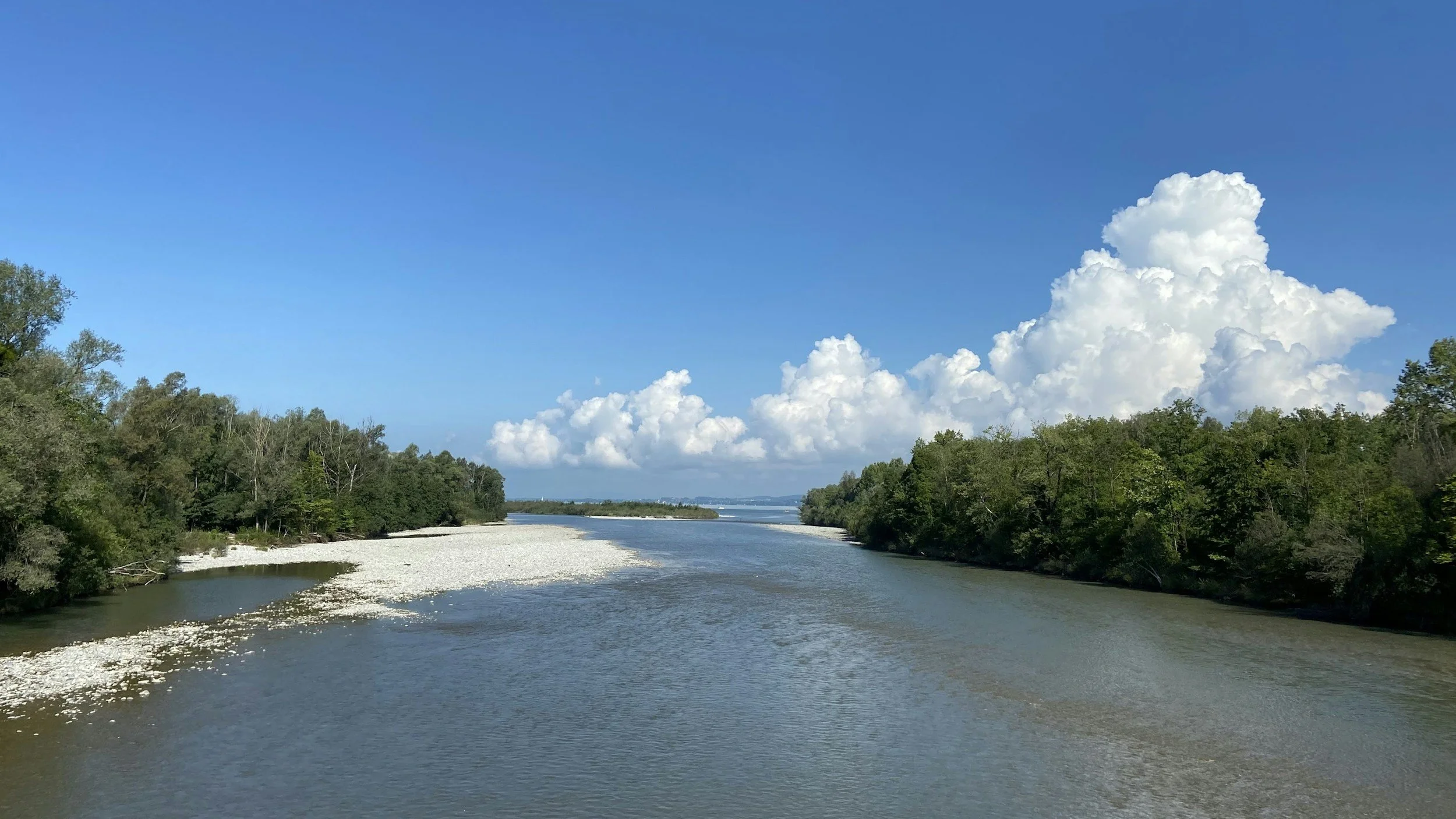
One of my favorite poems, entitled ‘Fear’, describes the contemplation of a river, as she pauses at the edge of the sea. She looks back at the peaks and forests she’s crossed along the way, then ahead at an ocean so vast that entering it seems like disappearing forever. She trembles…
When I first came across the poem years ago, it was attributed to Kahlil Gibran, the Lebanese poet and philosopher, and author of the small but mighty book ‘The Prophet’. If you haven’t read this yet, it’s profound, but also so sweet and simple that I read it to my daughters as a bedtime story.
I recently learned that it wasn’t actually written by Gibran, but is now generally attributed instead to Osho (Bhagwan Shree Rajneesh), the brilliant spiritual philosopher and also horrible cult leader, responsible for the mass poisoning of an entire community in Oregon. Osho’s followers rigged a plan to sway a county election by spraying the salad bars in ten restaurants in The Dalles with salmonella, sickening hundreds of residents. This microbial assault by deranged devotees is still considered the largest bioterrorism attack in U.S. history. I was in college in Portland in the early 90s, and stories of Osho’s fleet of Rolls Royces parading through town were still local legend. You can hear the complete story in the weirdly captivating Netflix documentary series Wild Wild Country.
Osho frequently reflected on Gibran in his teachings, and this perhaps explains the misattribution of the poem to Gibran in many sources. Despite now knowing of its somewhat repellent origin, I still love the poem. I also know well the tremble it describes, that of one standing on the brink of something formidable. Even as an experienced diver, I still sometimes feel a quiver on the dive boat, gear on, waiting for my giant stride into the ocean’s embrace. Maybe you’ve felt it at the base of a challenging climb, before trying a new balancing pose, or when you’re about to stand and speak before a room full of strangers. Your heartbeat quickens and echoes in your ears. Your palms go damp as your throat goes dry. Your stomach begins to buckle.
Here’s the curious part: Physiologically, fear and excitement create almost the same shift in the body. What separates them is not the sensation or the response itself, but the story your brain tells you about it.
Same Rush, Different Label
Psychologists can map complex emotions along two dimensions. A spectrum of arousal describes how agitated your physical body becomes; fear and excitement both occupy the high end of that scale. Valence describes whether your brain registers the experience as positive or negative. That second dimension is a judgment call, and it is with this judgement that the two emotions part ways.
Think of riding on a roller coaster versus in a car with no brakes. You experience the same drop in your stomach, but you’ll have a very different story to tell your friends later. Your heart doesn't know whether that lit candle belongs to a stick of dynamite or a birthday cake. It only knows that something exciting is about to happen. The difference is in the label that your brain applies.
And your inner labeler is a cautious one. The amygdala, a small almond-shaped structure deep within the medial temporal lobes of the brain, can be thought of as a bit like a highly vigilant smoke detector. It would rather sound the alarm a hundred times for burnt toast than miss one real fire. This is a design setting optimized for survival, but less ideal for your first rappel down a rock face. Many of our most profound "I can't do this" moments may simply be excitement that our amygdala has mislabeled as danger.
The Dread Before the Dive
Ralf Buckley, a surfer and researcher who has spent decades studying high-risk adventure, found that the apprehension we feel before a risky event differs from the fear we feel during it (Buckley, 2016). Anticipatory dread grows with the time we have to contemplate what's coming. This explains why ten minutes on the boat with nothing to do but think can bring far more anxiety than the dive itself.
The changes in our physiology track this. Acute fear is fast and sharp, driven by an adrenaline surge that fades once the moment passes. Anxiety is slower and more sustained, leaning on cortisol and fueled by uncertainty. Fear responds to the wave in front of you, whereas anxiety responds to every wave you can imagine, before you ever get in the water.
Buckley offers an important line for the (sometimes wobbly) adventurer: fear boosts performance, but panic causes paralysis. He describes a "sawtooth" relationship between fear and thrill. At low risk, we feel thrill with no fear at all; as the risk climbs, both thrill and fear rise together, until an upper threshold is reached where the thrill vanishes and only fear remains. Rewarding adventure lives in the middle, where we can hold both sensations and still function (and go home afterwards to tell the story).
Courage Writes a New Memory
What happens after we face something scary and come through it safely? A 2025 study from Susumu Tonegawa's lab at MIT offers a lovely piece of the answer (Zhang et al., 2025). When the brain learns that something we once feared is no longer dangerous, a process known as fear extinction, it doesn't erase the original memory but writes a new and more dominant one that suppresses it.
That new memory forms in the reward-responsive neurons of the amygdala, and the teaching signal is dopamine. The onset of activity observed in this subset of neurons lined up with the precise moment when the animals stopped freezing. Right as the fear let go, the brain left itself a note: we're okay, let’s remember this for next time.
These were mice, and obviously none of them were scuba diving. Still, this circuitry is ancient and shared across mammals and it suggests a beautiful way to think about courage. Each time we move through fear and discover that we are safe, our brains reward us with a rewrite. We get an updated version of both our perception of reality and our understanding of our place within it. That may be part of why the thrill afterward feels so good, and why doing hard things safely, again and again, makes them easier and more immediately enjoyable.
Why Leave the Riverbank?
If staying upstream is safer, why go at all? Some of the most interesting answers come from children. Psychologists Helen Dodd and Kathryn Lester propose that adventurous play, like climbing trees or racing bikes downhill, may help protect kids from later anxiety (Dodd & Lester, 2021). In a thrilling but relatively low-risk setting, children learn what a racing heart feels like and discover they can cope with it.
A recent scoping review by Tonia Gray and colleagues found positive associations in every one of the 40 studies it examined on risky outdoor play and adventure education. Eight central themes emerged, including resilience and confidence, autonomy, and a deeper bond with nature, (Gray et al., 2025). The authors argued that safety should be only "as safe as necessary," and not "as safe as possible." In other words, some level of risk is not only acceptable but is intrinsically coupled to the reward. These studies focused on young people, so we shouldn't overinterpret the findings, but I believe the lesson carries no obvious age limit: uncertainty is tolerable, and excitement with inherent risk is survivable.
Adults who chase big adventures tell a similar story. Susan Jackson and colleagues surveyed 199 highliners, climbers, downhill mountain bikers, freefallers, and snow-sport athletes (Jackson et al., 2023). Risk-seeking didn't even appear as a key motive, but mastery, connection to the activity, and trust in their own skills did, along with more frequent experience of flow state. It was never about the fear but the expanded definition of ourselves that waits for us on the other side.
Name It, Feel It, Thank It
The good news is that we can choose to become active participants in the labeling process. Harvard researcher Alison Wood Brooks found that people who said "I'm excited" before singing karaoke or giving a speech performed better than those who actively tried to calm down (Brooks, 2014). Telling yourself to relax before a nerve-racking event or task asks your body to drop from a ten to a two. Instead, we can intentionally name the sensations as excitement, honoring the energy of the moment and simply changing its story. Putting our feelings into words measurably quiets the amygdala (Lieberman et al., 2007). Coupling this intentional reframe with a slow exhale, slightly longer than our inhale, gently puts the brakes on our racing hearts and minds.
These ideas all come together in the practices I teach on my WildCalm retreats, where we choose to embrace adventure in order to expand our definitions of what we’re capable of.
Try it for yourself now. Picture yourself standing before something that makes your heart beat a little faster: diving into a vast blue ocean, standing at the edge of a precipitous canyon, perhaps just finally starting a difficult conversation that’s been festering. Notice what shifts in your body.
Name it. This is anxiety, or this is excitement. You don't need to be sure which, but you do have a choice.
Feel it. Where does it land? A constriction in your chest, a fluttering stomach, a tightening in your jaw? Notice it without fixing it. Breathe in slowly to what is, then out for even longer.
Thank it. This reaction isn't a stop sign, it’s simply your brain doing the job that it has done faithfully your whole life: trying to keep you safe. You can thank it and still choose to step forward into the experience. You decide what happens next.
The river, in the end, cannot go back. She enters the ocean, and only then does she understand that she isn't disappearing, but instead she is becoming the ocean. The river trembles. Then she goes anyway. That is the whole practice.
Fear
By Kahlil Gibran Osho?
It is said that before entering the sea
a river trembles with fear.
She looks back at the path she has traveled,
from the peaks of the mountains,
the long winding road crossing forests and villages.
And in front of her,
she sees an ocean so vast,
that to enter
there seems nothing more than to disappear forever….
….The river needs to take the risk
of entering the ocean
because only then will fear disappear,
because that's where the river will know
it's not about disappearing into the ocean,
but of becoming the ocean.
What new experience is calling to you? What if this could be the moment you step across that threshold—not despite the fear, but because of the magic waiting on the other side?
